
For many orchardists and vineyard managers, frost has always been one of those risks that sits quietly in the background of every season. It is rarely discussed during the warmer months, but when temperatures begin to drop, it quickly becomes the one factor capable of undoing weeks or even months of careful work.
Historically, frost management followed patterns that growers understood well. Certain blocks were known to be more vulnerable than others. Certain times of the season carried greater risk. Growers relied on local knowledge, long-term observation and experience passed down through generations to anticipate when protection might be needed.
While frost was never welcome, it was at least somewhat predictable.
Today, that predictability is becoming less certain.
Across many horticultural regions in New Zealand and Australia, growers are observing subtle but important shifts in weather patterns. Cold nights are sometimes appearing earlier in the season, lingering longer than expected, or arriving during periods that historically carried very little frost risk. In some cases, temperature drops can occur with little warning, leaving growers with very narrow windows to respond.
For growers managing high-value crops, this increasing variability means that frost protection strategies need to evolve.
Climate Variability Is Changing Seasonal Patterns
Climate variability is not a new concept, but its effects are becoming increasingly visible across agricultural systems. Seasonal weather patterns are influenced by complex atmospheric conditions that affect how heat is retained or lost during the night.
Research from New Zealand’s National Institute of Water and Atmospheric Research (NIWA) has highlighted how regional climate patterns are shifting in ways that can influence frost behaviour. Similarly, agricultural reporting from ABARES in Australia frequently points to climate variability as a growing operational challenge for farmers and horticultural producers.
What this means in practical terms is not necessarily that frost events are increasing everywhere, but rather that they are becoming less predictable.
For growers, unpredictability can often be more difficult to manage than frequency. When frost risk no longer aligns neatly with traditional seasonal expectations, the margin for error becomes much smaller.
The Real Cost of Frost Damage
Frost damage rarely occurs at a convenient stage in the growing cycle. It often arrives during periods when crops are most vulnerable.
Bud development, flowering and early fruit formation all represent delicate phases in plant growth. During these stages, plant tissue contains high levels of moisture and can freeze quickly when temperatures fall below critical thresholds.
Once that damage occurs, the effects can last for the entire season.
A frost event that destroys blossoms in an orchard may significantly reduce yield months later during harvest. In vineyards, frost can damage young shoots that would otherwise produce the year’s fruiting canes.
For high-value crops such as grapes, apples, cherries and kiwifruit, the economic impact can be considerable.
This is why frost protection is rarely viewed as a secondary concern in modern horticulture. It is a central component of protecting productivity.
Passive Protection Remains Important
Traditional orchard design has always incorporated passive frost protection strategies. Site selection is often the first and most important decision. Growers prefer locations where cold air can drain away naturally rather than settling in low pockets of land.
Tree spacing, canopy management and block layout can also influence how air moves across an orchard.
These passive strategies remain essential today. They form the foundation of good orchard design and help reduce overall frost exposure.
However, as seasonal conditions become less predictable, passive strategies alone are not always sufficient.
Many growers now complement these approaches with active frost protection systems that can respond when temperatures begin to fall.
Why Air Movement Can Protect Crops
Most frost damage in orchards occurs during radiation frost events. These develop on clear nights when heat absorbed by the ground during the day gradually escapes into the atmosphere.
As the ground cools, the air closest to the surface becomes colder and denser, settling around the crop canopy. Meanwhile, slightly warmer air remains a few metres above the orchard.
This temperature inversion creates the conditions where frost forms around sensitive plant tissue.
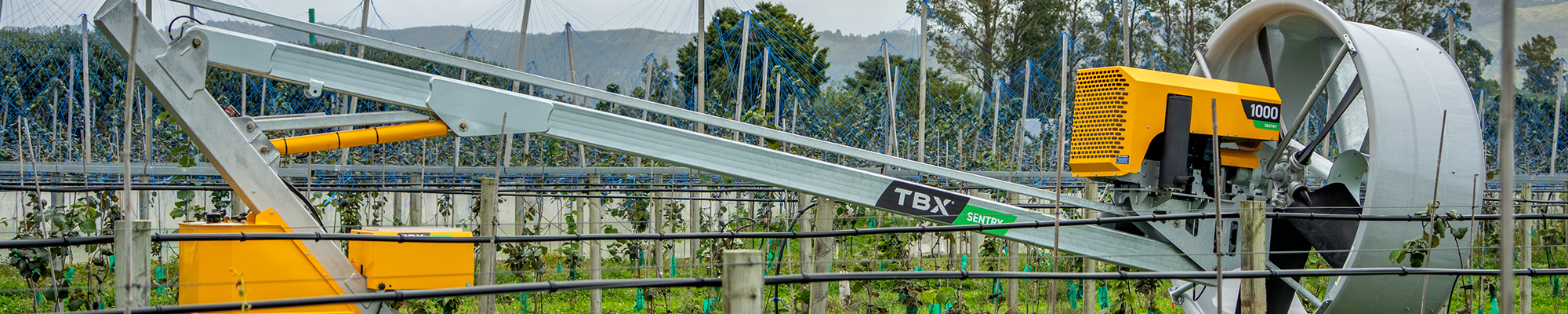
Wind machines take advantage of this natural layering of air.
By pulling the slightly warmer air from above and circulating it across the orchard canopy, wind machines mix the air layers together and raise the temperature around the crop.
In many situations, even a small increase in temperature can prevent frost damage from occurring.
Modern frost fan systems, including those developed by TBX, are designed to deliver consistent airflow across orchard blocks, helping growers maintain stable conditions during cold nights when frost risk is highest.
Frost Protection as a Long-Term Strategy
One of the most noticeable changes within the horticultural industry is the shift in how growers approach frost protection planning.
Rather than viewing frost protection equipment as something installed only after damage has occurred, many orchard developers now consider frost risk during the earliest stages of orchard establishment.
This approach involves studying land contours, airflow patterns and microclimates to determine where frost protection systems should be placed for maximum effectiveness.
By planning ahead, growers can design orchards that are more resilient to environmental pressures.
Looking Ahead
Frost will always remain a natural part of growing fruit in many regions of New Zealand and Australia. What is changing is the way growers approach that risk.
As climate variability continues to influence seasonal patterns, the ability to respond quickly to cold events is becoming increasingly important.
For many growers, frost protection systems now represent an investment not only in protecting a single season’s crop, but in safeguarding the long-term productivity of the orchard.
Because ultimately, frost protection is not simply about preventing damage on a cold night.
It is about protecting the future potential of the land itself.
References
National Institute of Water and Atmospheric Research (NIWA)
https://niwa.co.nz/
Australian Bureau of Agricultural and Resource Economics and Sciences (ABARES)
https://www.agriculture.gov.au/abares
Hort Innovation – Frost Management Resources
https://www.horticulture.com.au