
Types of Frost Protection: Comparing the Options for Orchards and Vineyards
Frost can cause significant damage to orchards, vineyards and other high-value horticultural crops, sometimes within only a few hours. When temperatures fall at a vulnerable growth stage, buds, flowers, young shoots and developing fruit can all be at risk, potentially affecting both yield and crop quality.
For growers, the challenge isn't simply deciding whether frost protection is necessary. It's determining which type of frost protection is best suited to the property, crop and frost conditions.
There are several active frost protection methods used across horticulture, including water sprinkler systems, heating, helicopters and frost fans. Each works differently and comes with its own advantages, limitations and infrastructure requirements.
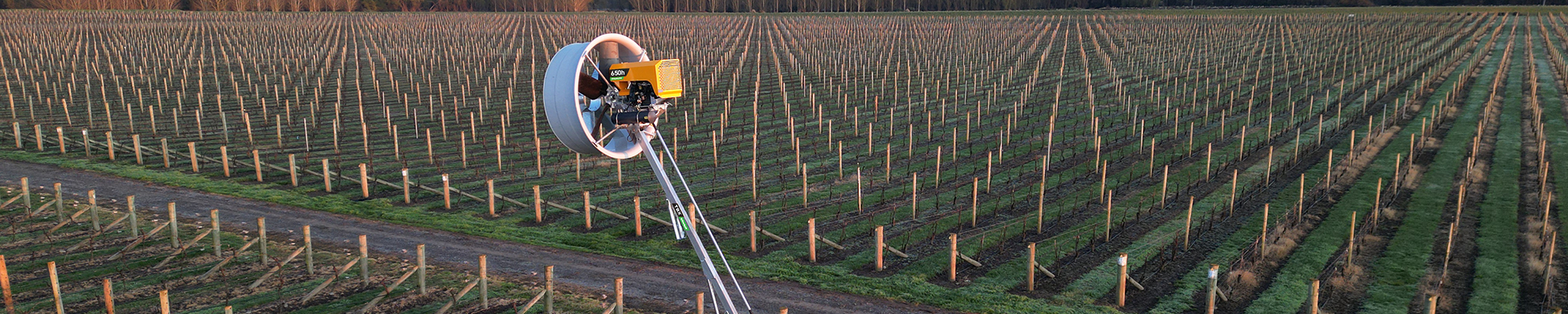
For orchards and vineyards that regularly experience radiation frost with a suitable temperature inversion, frost fans can offer a particularly practical long-term approach. They don't require continuous water application during a frost event and, once installed, fixed systems can provide repeatable protection without the event-by-event logistics associated with options such as helicopters.
However, frost fans aren't suitable for every frost event. Their effectiveness depends heavily on the atmospheric conditions present – which is why understanding the type of frost you're dealing with should come before choosing any protection system.
Frost Protection Methods at a Glance
|
Method |
How it works |
Water required? |
Key requirements |
Generally suited to |
|
Water sprinklers |
Uses heat released as applied water cools and freezes |
Yes |
Reliable water supply, pumping capacity and continuous application
|
Crops with suitable irrigation infrastructure and adequate water |
|
Electric heating |
Adds heat directly around susceptible plant material |
No |
Electrical supply and infrastructure |
Targeted areas and high-value crops |
|
Helicopters |
Uses rotor wash to move warmer inversion air towards the crop |
No |
Suitable inversion, aircraft, pilot and flying conditions |
High-value areas during radiation frost |
|
Frost fans |
Mixes warmer inversion air with colder air around the crop |
No |
Suitable temperature inversion and appropriate site conditions |
Orchards and vineyards regularly experiencing radiation frost |
The differences between these systems become much clearer once you understand the frost event itself.
First: What Type of Frost Are You Dealing With?
Before comparing frost protection systems, it's important to understand that not every frost event develops in the same way.
Radiation frost generally develops during clear, calm conditions as heat is lost from the ground overnight. Air close to the ground becomes colder while warmer air may remain above it, creating what is known as a temperature inversion [1].
This inversion is particularly important for frost fans and helicopters because these methods rely on moving and mixing warmer air from above with the colder air surrounding the crop.
Advective frost, on the other hand, occurs when cold air moves into an area and is generally associated with stronger winds. A useful temperature inversion may not be present, limiting the effectiveness of systems that rely on air mixing [1][2].
This distinction is important.
If warmer air exists above the crop during a radiation frost, an air-mixing system may be able to make use of that available heat. If there is little or no inversion, a frost fan has much less useful warm air available to redistribute.
Understanding the frost conditions experienced on a property is therefore an important first step before investing in any frost protection system.
For more on changing frost conditions, read Frost Risk is Changing – And Growers Are Adapting.
1. Water Sprinkler Frost Protection
Sprinkler irrigation is one of the established methods used to protect horticultural crops from frost.
Although applying water during freezing temperatures may sound counterintuitive, the science behind the method is well established. As water cools and freezes, energy is released as heat. With adequate and continuous application, this can help prevent susceptible plant tissue from falling to more damaging temperatures [1][2].
The important consideration is that water application needs to be sufficient and continuous throughout the protection period. A reliable water supply, appropriate pumping capacity and uniform coverage are therefore essential.
When water availability becomes a consideration
Growers also need to consider existing soil and weather conditions.
If a frost follows a period of heavy rainfall, soils may already be saturated or close to field capacity. Applying additional water can potentially contribute to waterlogging, poor soil aeration and additional stress on root systems, particularly in blocks with limited drainage.
This means growers considering sprinkler frost protection need to look beyond the forecast temperature and consider water availability, recent rainfall, soil moisture, drainage and the volume of water that may be required throughout an event.
For properties where water is constrained – or where avoiding additional water application is desirable – water-independent protection methods may warrant consideration.
2. Electric Heating for Frost Protection
Adding heat is another established approach to frost protection.
Traditional systems have included fuel-burning orchard heaters, while research has also explored targeted electrical heating technologies.
Australian research from the University of New England, for example, investigated electrical heating cables around grapevine cordons and demonstrated that targeted heating could reduce frost damage under the trial conditions [3].
While targeted heating can be effective in certain situations, growers need to consider the area requiring protection, crop value, power requirements and the cost and practicality of installing the necessary infrastructure.
This can make heating particularly relevant for targeted or high-value areas rather than necessarily providing a practical solution across every large orchard or vineyard.
3. Helicopters for Frost Protection
Helicopters have also been used for frost protection in horticultural regions.
The principle is actually similar to a frost fan.
During a radiation frost with a temperature inversion, warmer air sits above the colder air surrounding the crop. Rotor wash from a helicopter can help move that warmer air towards the surface [2].
Mobility is one of the advantages of this approach, as a helicopter can move between different areas and concentrate activity where protection is required.
However, there are practical considerations around aircraft availability, experienced pilots, suitable flying conditions and operating costs. Protection also needs to be organised when individual frost events occur.
Most importantly, just like a frost fan, the technique relies on having useful warmer inversion air available to redistribute [2].
4. Frost Fans
Frost fans – also known as wind machines – are an established method of protecting horticultural crops during radiation frost.
A common misconception is that a frost fan simply "blows the frost away".
That's not quite what is happening.
During a radiation frost, colder air develops around the crop while warmer air may remain above it. Frost fans create air movement that mixes these layers, bringing warmer inversion air down into the colder crop environment.
Rather than generating large quantities of heat, the fan is effectively helping growers make use of heat already present within the atmosphere.
For a deeper explanation, read How Wind Machines Protect Orchards and Vineyards From Frost.
Why growers consider frost fans
For properties with suitable radiation frost conditions, frost fans offer several practical characteristics.
They don't require continuous water application during a frost event, making them particularly relevant where water availability is limited or additional irrigation isn't desirable.
Fixed frost fans also provide permanent frost protection infrastructure. Rather than arranging equipment for each individual event, the system remains in place and can be ready to operate when the appropriate conditions occur.
Portable frost fans provide another option, allowing equipment to be moved between blocks depending on frost risk and operational requirements.
Their effectiveness, however, remains dependent on site and atmospheric conditions. In particular, there needs to be a useful temperature inversion containing warmer air that can be mixed into the colder crop zone.
Understanding inversion strength, topography, cold-air drainage and the area requiring protection is therefore an important part of assessing whether a frost fan is appropriate for a particular property.
Fixed or portable frost fans?
Growers can choose between permanent and portable systems depending on the layout and requirements of their operation.
The TBX Sentry range provides a fixed frost protection option, including the Sentry 800 and Sentry 1000. TBX specifies coverage of up to 7 hectares for its Sentry machines, depending on site conditions.
For more on the larger Sentry model, read Introducing the TBX Sentry 1000: A New Era in Frost Protection.
Portable frost fans provide a different approach. Rather than remaining permanently installed in one location, they can be repositioned to protect different blocks.
TBX's Tow & Blow machines are designed around this flexibility. See Portable Frost Machine in Action for an example of portable frost protection in practice.
Frost Fans vs Sprinklers: What's the Difference?
Frost fans and sprinklers can both form part of a frost management strategy, but they work on fundamentally different principles.
Sprinklers use water. Heat released as applied water cools and freezes helps protect susceptible plant tissue [1][2].
Frost fans use air movement. They redistribute warmer inversion air into the colder air surrounding the crop [2].
This creates an important operational difference.
Sprinkler systems require an adequate and continuous water supply throughout the protection period. Frost fans don't require water during operation, but their effectiveness depends on the presence and strength of a suitable temperature inversion.
For orchards and vineyards that regularly experience radiation frost and have suitable inversion conditions, this can make frost fans an attractive long-term option, particularly where water availability, irrigation capacity or additional water application are concerns.
The two technologies don't necessarily have to be considered in isolation either. The FAO documents the use of under-plant sprinklers in combination with wind machines as one example of combined active frost protection [2].
Frost Protection for Different Crops
The appropriate frost protection strategy also depends on the crop being protected.
Young kiwifruit shoots and developing buds, for example, can be particularly vulnerable during sensitive stages of development. For more information, read Why Frost Protection Is Critical for Kiwifruit Orchards.
Vineyards have their own frost-management considerations, particularly around budburst and early shoot development. Growers can also explore TBX's dedicated vineyard frost protection solutions for fixed and portable fan options.
Crop height, topography, block layout and cold-air drainage can all influence the type, configuration and placement of frost protection equipment.
Which Frost Protection Method Is Right for Your Property?
There is no single frost protection method that is right for every orchard, vineyard or horticultural operation.
Before investing in a system, growers should consider:
- typical frost type and frequency
- historical minimum temperatures
- temperature inversion strength
- crop type and vulnerable growth stages
- property topography and cold-air drainage
- area requiring protection
- water availability
- existing power and irrigation infrastructure
- installation requirements
- ongoing operating costs and logistics.
For growers considering a frost fan, understanding the temperature profile above the crop is particularly useful.
A temperature reading at crop level tells you how cold the crop environment is. Measuring temperatures higher above the ground can help determine whether warmer air is available to be brought down – and therefore whether an air-mixing system is likely to be suitable.
Can Different Frost Protection Methods Be Combined?
Yes.
Frost protection doesn't always need to involve choosing one method exclusively.
The FAO recognises combinations of active frost protection methods, including wind machines with under-plant sprinklers, wind machines with surface irrigation and wind machines with heaters [2].
Active protection can also sit alongside passive frost-management practices such as managing cold-air drainage, understanding frost-prone areas and considering frost risk when establishing new blocks.
Rather than simply asking:
"Which machine stops frost?"
A more useful question is:
"What frost conditions occur on this property, and which protection method is best suited to those conditions?"
Choosing Frost Protection for Your Orchard or Vineyard
Ultimately, frost protection is about understanding and managing risk.
Sprinklers use energy released as water cools and freezes. Heating systems introduce heat directly into the crop environment. Helicopters redistribute warmer inversion air during suitable conditions. Frost fans use air movement to mix warmer inversion air with the colder air surrounding the crop.
Each approach has its place.
For orchards and vineyards that regularly experience radiation frost and have a suitable temperature inversion, frost fans can offer a practical long-term protection strategy without the continuous water requirements of sprinkler systems or the event-by-event logistics associated with helicopters.
Fixed and portable configurations also allow growers to select an approach that suits their property layout, crop and frost risk.
The key is establishing whether the conditions on the property are right for a frost fan in the first place.
Talk to TBX About Your Frost Conditions
Choosing a frost protection system should start with understanding your property rather than simply choosing a machine.
TBX develops fixed and portable frost fan solutions for vineyards, orchards and other horticultural crops, including the Sentry and Tow & Blow ranges.
If you're considering frost fans, the first step is understanding your frost history, temperature inversion, crop, topography and the area requiring protection.
Explore TBX frost protection solutions or talk to the TBX team about whether a fixed or portable frost fan is suitable for your property.
Frequently Asked Questions
What are the main types of frost protection?
Common active frost protection methods include sprinklers, heating, helicopters and wind machines or frost fans. Each works differently, so suitability depends on the crop, property and type of frost event.
Are frost fans better than sprinklers?
Neither system is universally better. They work in different ways and depend on different resources and conditions.
Sprinklers rely on adequate and continuous water application, while frost fans rely on air movement and a suitable temperature inversion. For orchards and vineyards that regularly experience radiation frost with an appropriate inversion, frost fans can provide a practical water-independent option.
How do frost fans work?
Frost fans mix warmer air from a temperature inversion with colder air surrounding the crop. For a more detailed explanation, read How Wind Machines Protect Orchards and Vineyards From Frost.
Do frost fans need water?
No. Frost fans use air movement rather than water application, making them an option for operations where water availability may be constrained or where growers want to avoid applying additional water during frost events.
Do frost fans work during every frost?
No. Frost fan performance depends on atmospheric conditions.
They are primarily suited to radiation frost events where a suitable temperature inversion is present. During advective frost, stronger winds and the absence of a useful inversion can significantly limit the effectiveness of air-mixing systems.
Can different frost protection methods be used together?
Yes. Agricultural guidance recognises combinations such as wind machines with under-plant sprinklers, depending on the crop, site and frost conditions [2].
References
[1] Ontario Ministry of Agriculture, Food and Agribusiness. Freeze Protection Methods for Crops.
[2] Food and Agriculture Organization of the United Nations (FAO). Frost Protection: Fundamentals, Practice and Economics – Active Protection Methods.
[3] University of New England. Vineyard Frost Protection – Electrically Heated Cables Protect Vine from Frost Damage at Flowering.